Cypress, TX · Garage Door Service
Broken spring or dead opener at 6am? We work on the 1980s-90s torsion and extension setups common across the Cypress area, day or night.
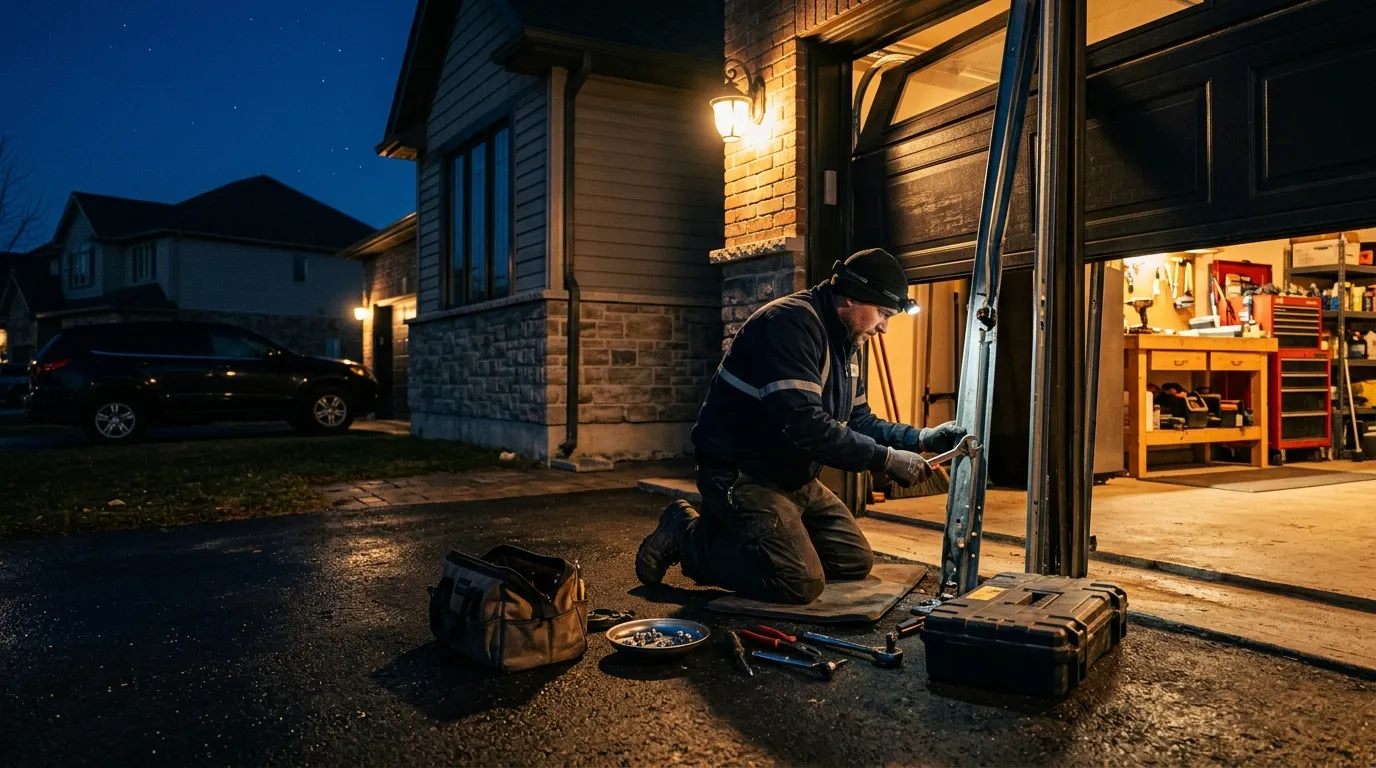
Most houses across this service area went up between 1971 and 2002, with the heaviest run of construction landing in the 1980s and 90s across the 14 named communities we cover. That's not a small detail - it means a huge share of the garages we get called to still have the original torsion spring, or in older cases an extension spring setup, riding on hardware that was never meant to run for thirty-plus years without a rebuild.
Heat plays a role too, though it's a moderate factor here compared to harsher climates - the bigger issue is just age. Steel fatigues on a predictable cycle no matter how mild the weather is, and a spring rated for around 10,000 cycles doesn't care that it's a nice day out. A door opened twice a day for 25 years has already put well over 18,000 cycles on that spring. That math is why so many emergency calls we get aren't freak accidents - they're springs finishing a job they started doing in the late 1980s or early 1990s.
Openers follow the same pattern. A chain-drive unit installed when the house was built is well past any reasonable service life, and the gears, capacitor, and logic board inside it are wearing out on the same clock as the spring next to it. When one goes, the other often isn't far behind.
We don't post a flat number here because a broken torsion spring on a single door and a dead opener logic board aren't the same job, and pretending they cost the same isn't honest. What we can tell you is what drives the number up or down: door weight (steel is heavier than aluminum, insulated heavier than not), whether you've got one spring or two, whether the drum or cable needs replacing along with the spring, and whether the opener is a straightforward swap or something wired into a smart-home setup.
With a median household income of $95,273 across the service area, most of the calls we take are for straightforward repairs, not full system replacements - people fix what broke rather than starting over, and for a house from the 1980s or 90s that's usually the right call. Replacement only makes sense when the door itself is warped, the track is bent beyond adjustment, or the opener has failed more than once in a short window.
We'll give you a real number after we look at the door, not before. That's the honest version of an emergency repair quote - anything given over the phone before we've seen the spring, the drums, and the opener is a guess.
A torsion spring going usually doesn't wait for a convenient time. The door feels heavy under the opener, or it slams down the last foot of travel instead of settling. Sometimes you hear it before you see it - a loud bang from the garage, which is the spring letting go all at once rather than gradually loosening.
Extension springs, more common on the older end of the 1971-2002 stock, tend to sag or stretch unevenly first, so the door goes up crooked or drags on one side of the track before it fails outright.
Opener failure looks different: the motor runs but the door doesn't move, or it moves a few inches and reverses, or the remote works some days and not others. On a chain-drive unit from that era, a stripped gear or a burnt-out capacitor are the usual suspects.
Either way, a door that won't open is a locked-in car or a security gap, and a door that won't close is worse - it's an open garage overnight. That's the kind of thing that doesn't wait for business hours, which is why we run this as an emergency line rather than a scheduled-appointment-only service.
Because so much of the housing stock in this service area dates to the 1980s and 90s, we stock the torsion springs, cables, rollers, and drum sets sized for that generation of door - the parts that fit a standard 7-foot or 8-foot residential opening built to spec in that window. We also carry common opener parts for chain and belt-drive units from that era: capacitors, drive gears, and logic boards for the brands that were standard installs on new construction back then.
Where we run into lead time is on doors that predate that main construction window or on specialty panel styles that were never mass-produced - those sometimes need an ordered part rather than something off the truck. We'd rather tell you that up front than promise a same-day fix we can't deliver.
For the run-of-the-mill emergency - a snapped spring, a stripped opener gear, a cable off the drum - we're carrying what a house from this stretch of construction is likely to need, because that's most of what we see, call after call.
We run this as an emergency line, so we don't schedule a broken-spring call days out. Call and we'll tell you honestly where we are in the queue and give you a window, rather than a vague 'soon.'
Yes. A torsion spring holds serious tension and has hurt people who tried to release or replace it without the right bars and clamps. If the spring's gone, leave the door down, don't force the opener, and call someone who does this daily.
That's most of what we work on. A large share of houses across this area were built between 1971 and 2002, so the springs, drums, and openers from that period are the bulk of our emergency calls, not the exception.
Could be either. A door that lifts on its own or drifts open is usually a spring issue - too much tension pulling it up. A door that closes then reverses is more often the opener's travel limits or a safety sensor. We'd need to look at it to say for sure.
By Neighborhood
We also handle emergency garage door in these Cypress-area suburbs.
Call now or request a free quote - same-day service on most repairs, upfront written pricing.